
Does Medicare pay for walk in tubs, Owasso
Does Medicare, Medicaid or the VA pay for a walk-in tub? What actually gets covered in Oklahoma, and how to ask
- Aging in Place
- Paying for It
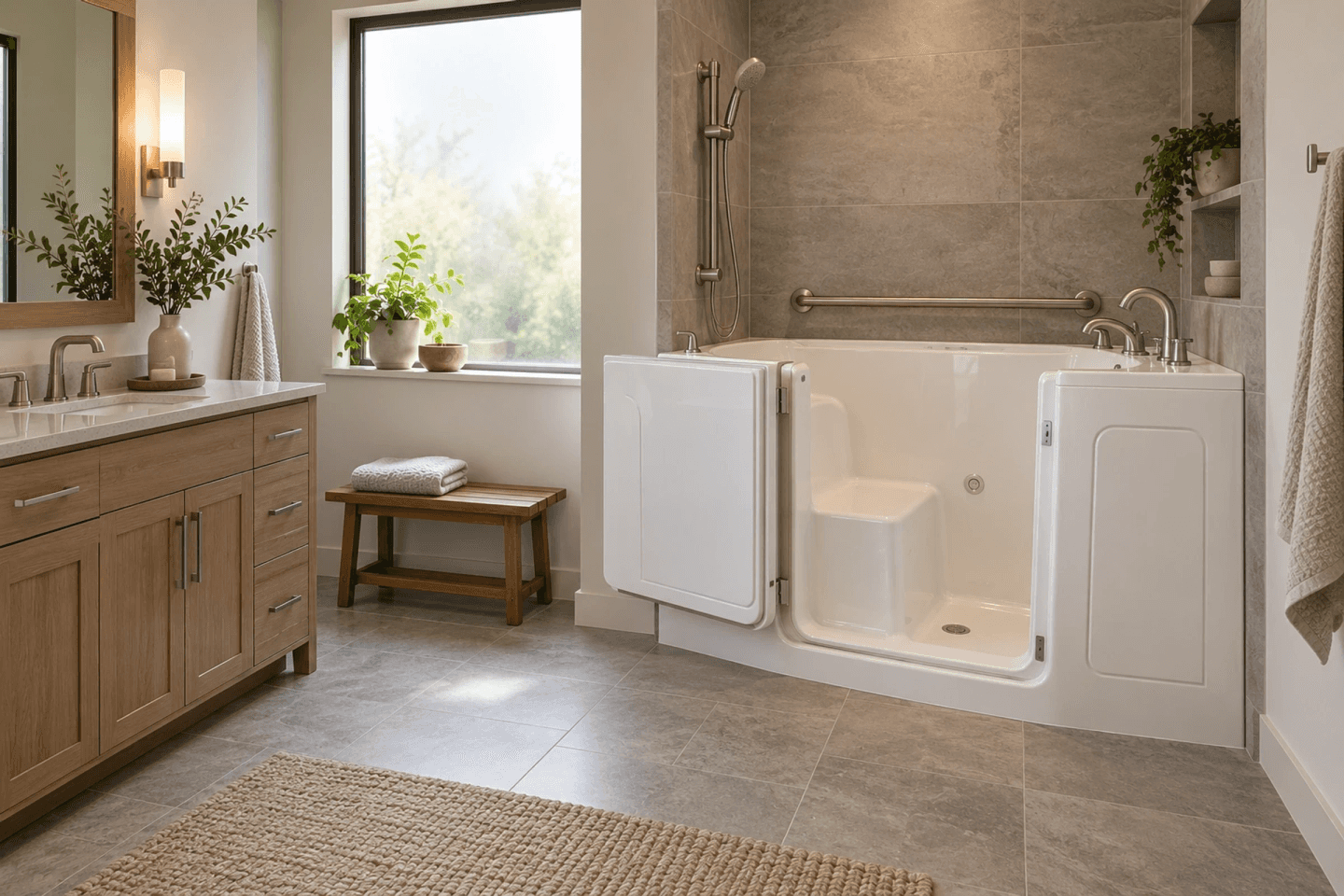
If you are helping a parent bathe safely, you have probably heard that a walk-in tub is “covered by Medicare.” It is not, and the sales pitch that says it is has cost families money. The honest answer is more useful than the pitch: Medicare almost never pays, but several other programs sometimes do, and the right choice may not be a tub at all.
This guide is written for the adult child or caregiver in Owasso and across the Tulsa area who needs to know who might pay, what each program really requires, what paperwork to gather, and which claims to question. Rules and dollar limits change, so we link the official source for each one and tell you who to call to confirm.
The short answer: who might pay for a walk-in tub
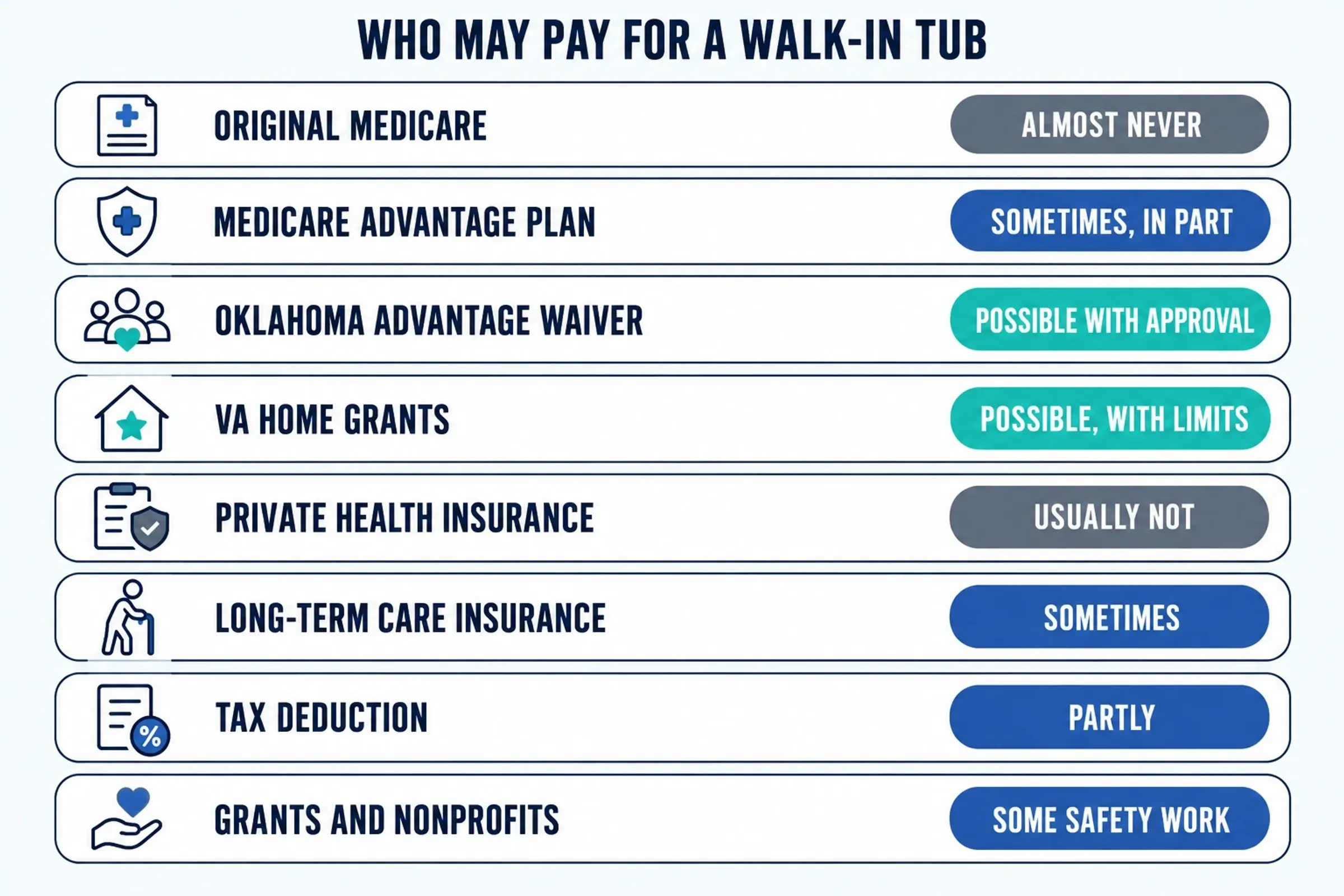
Who may pay for a walk-in tub. Almost every answer starts with “check your plan.”
| Source | Does it pay for a walk-in tub? | What decides it |
|---|---|---|
| Original Medicare (Parts A and B) | Almost never | A tub is a home modification, not durable medical equipment |
| Medicare Advantage plan | Sometimes, in part | Whether your plan offers a bathroom safety benefit and how large it is |
| Oklahoma Medicaid (ADvantage Waiver) | Possible with approval | Meeting the waiver’s medical and financial rules, an open spot, and prior authorization |
| VA (HISA, SAH, SHA) | Possible, with limits | Disability rating, lifetime caps, and the VA’s view of the tub type |
| Private health insurance | Usually not | Policy terms |
| Long-term care insurance | Sometimes | Whether the policy covers home modification |
| Taxes | Partly, as a deduction | Whether you itemize and your income |
| Grants and nonprofits | Some safety work | Income, age, location and funding |
Does Medicare pay for walk in tubs?
Almost never. Medicare’s own rules explain why. Medicare.gov describes covered durable medical equipment as equipment that is:
- durable, meaning it can withstand repeated use,
- used for a medical reason,
- typically useful only to someone who is sick or injured,
- used in your home, and
- expected to last at least three years.
A walk-in tub fails the third test and is built into the house, which makes it a home modification. Medicare Interactive, a service of the Medicare Rights Center, says Medicare does not cover home modifications even when a doctor recommends them, and its list of excluded equipment names items meant mainly for convenience or comfort, such as grab bars and bathtub or toilet seats.
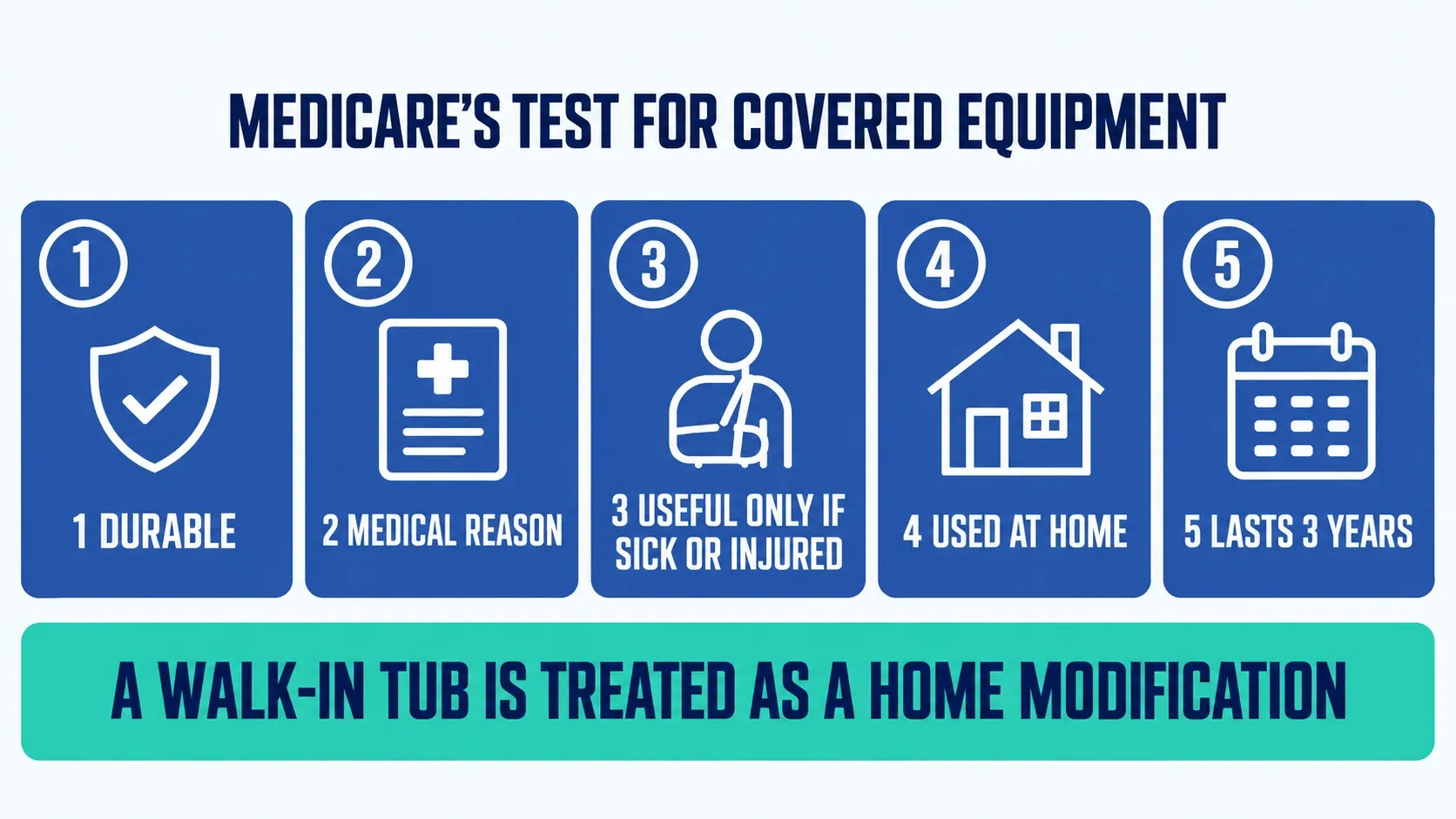
Medicare’s five-part test for equipment it covers. A walk-in tub is classed as a home modification.
You will see websites claim that a doctor’s prescription can win partial reimbursement. We could not find that in Medicare’s own rules, so do not count on it. If anyone tells you a specific tub is “Medicare approved,” ask them to put it in writing and then check it yourself, as described in the red flags section below. You can also call 1-800-MEDICARE (1-800-633-4227) or the free state counselors at the Oklahoma Insurance Department’s Medicare Assistance Program at 1-800-763-2828.
Are walk in tubs covered by insurance? Check the Medicare Advantage plan
This is the one place Medicare dollars can show up. Medicare Advantage plans are allowed to offer extra benefits beyond Original Medicare, and since 2018 guidance the Centers for Medicare and Medicaid Services (CMS) has allowed “home and bathroom safety devices and modifications” on its non-exhaustive list of permitted supplemental benefits. It is optional for each plan. According to the KFF’s 2026 analysis, 21 percent of enrollees in individual Medicare Advantage plans were in plans that offered bathroom safety devices, compared with 60 percent in special needs plans. Even when a plan offers the benefit, it may mean grab bars and shower seats rather than a tub, with a yearly dollar limit.
How to check your plan in about 20 minutes
- Find your plan’s Evidence of Coverage online or call the member number on your card.
- Search it for “bathroom safety,” “home safety,” “home modification,” and “in-home support.”
- Ask these exact questions and write down the name of the person and the date:
- Does the plan pay for a walk-in tub, a walk-in shower, or only grab bars and seats?
- What is the dollar limit, and is it per year or for life?
- Do I need prior authorization or a doctor’s order?
- Do I have to use a specific supplier?
- Does the benefit cover installation?
Special needs plans, which serve people with chronic conditions or both Medicare and Medicaid, are more likely to include this benefit.
Does Medicaid pay for walk in tubs? How Oklahoma’s ADvantage Waiver works
In Oklahoma, this help usually comes through the ADvantage Waiver rather than everyday SoonerCare benefits. It is a Medicaid program that helps people stay home instead of moving to a nursing facility. Oklahoma Human Services runs it, and the state’s rule on ADvantage services lists environmental modifications as one of the services. Plan for these steps:
- Eligibility. The program serves adults 65 and older, and some younger adults with physical disabilities, who need nursing facility level of care and meet Medicaid’s financial rules. A county Human Services office handles the financial review, and a nurse visits the home for an assessment. The Human Services FAQ explains the process.
- A limited number of spots. The waiver can only serve a set number of people, so an open slot is part of approval.
- A therapist’s assessment. Environmental modifications have required an assessment by a physical therapist or skilled nurse of the person’s level of function, a decision tool, and owner permission if the person does not own the home. The most recent published packet requirements we found date from 2017, so ask your case manager for the current list.
- Prior authorization. Nothing should be ordered or installed before approval. Ask the case manager whether a walk-in tub, a walk-in shower or a roll-in shower fits the person’s plan of care. The assessment decides what is approved, which is sometimes a different fixture than the one you came in asking about.
We could not find a published dollar limit for the benefit, and we are not going to guess one. The case manager can tell you.
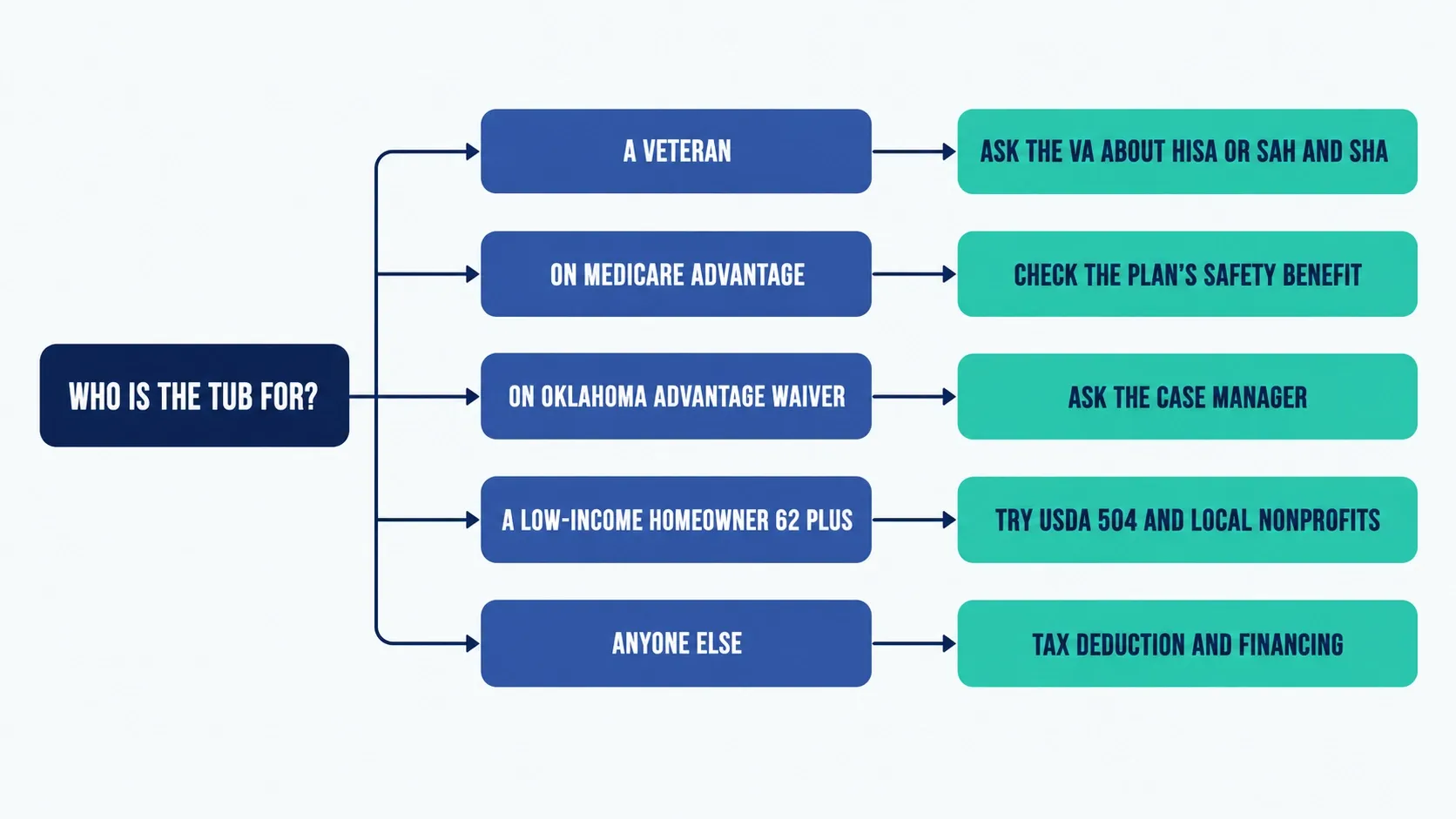
Which funding path might fit? Start at the top and follow your situation.
Does the VA pay for walk in tubs?
It may, in part, and the rules depend on the veteran’s disability and the type of tub. There are two kinds of help.
HISA (Home Improvements and Structural Alterations). The VA’s HISA page describes a lifetime benefit for medically necessary changes to a primary home, including essential bathroom and sanitary facilities. The listed limits are $6,800 for a service-connected disability (or a non-service-connected one if the veteran has a service-connected rating of at least 50 percent) and $2,000 otherwise. Two details matter for tubs:
- The VA names roll-in showers as an example of what it covers.
- It excludes “spa, hot tub or Jacuzzi-type tubs.” A walk-in tub is not mentioned either way, so a jetted model is the risky choice. Ask your Prosthetic and Sensory Aids Service (PSAS) before you buy anything.
Applications need a prescription from a VA physician, VA Form 10-0103, a written itemized estimate covering labor, materials and permits, and a color photo of the area as it is now. The VA may inspect. The page says to confirm your available benefit with your local PSAS because the dollar limits can change.
SAH and SHA grants. Veterans with certain severe service-connected disabilities may qualify for larger grants: for fiscal year 2026, the VA lists up to $126,526 for Specially Adapted Housing and $25,350 for Special Home Adaptation. The grants can be used up to six times over a lifetime, and the amounts are adjusted yearly.
Veterans who think they qualify should ask a VA social worker or a county Veterans service officer for help applying.
Walk in tub grants for seniors: other money to look for
Not much of this is walk-in-tub money. It is safety-change money, and a tub is sometimes a fit and sometimes is not.
- USDA Section 504 Home Repair. Grants of up to $10,000, for homeowners 62 and older with very low incomes, and loans of up to $40,000 for very-low-income homeowners, in eligible rural areas. The grant can fund removing health and safety hazards or making a home accessible for someone with a disability. Check your address on USDA’s eligibility map. Many city addresses do not qualify, and some rural edges do.
- Local repair nonprofits. Revitalize T-Town, formerly Rebuilding Together Tulsa, makes free home repairs for low-income Tulsa homeowners. Ask whether your address is in its area and whether bathroom safety work is something it does, and expect a waiting list.
- Your Area Agency on Aging. The Eldercare Locator (1-800-677-1116) connects you to the local office, which knows about programs that change from year to year.
- A medical expense deduction. IRS Publication 502 says home changes made for a disability, such as support bars and other bathroom modifications, can count as medical expenses, and that improvements that raise the home’s value are partly deductible (the cost minus the value increase). You must itemize, and only the amount above 7.5 percent of your adjusted gross income counts. Ask a tax professional.
- HSA and FSA accounts. Ask the plan administrator before you spend. Some require a letter of medical necessity.
- Long-term care insurance. Some policies cover home modification. Read the policy or call the insurer.
Build the paperwork before you ask anyone
Nearly every program above asks for the same five things. Gathering them once saves weeks.
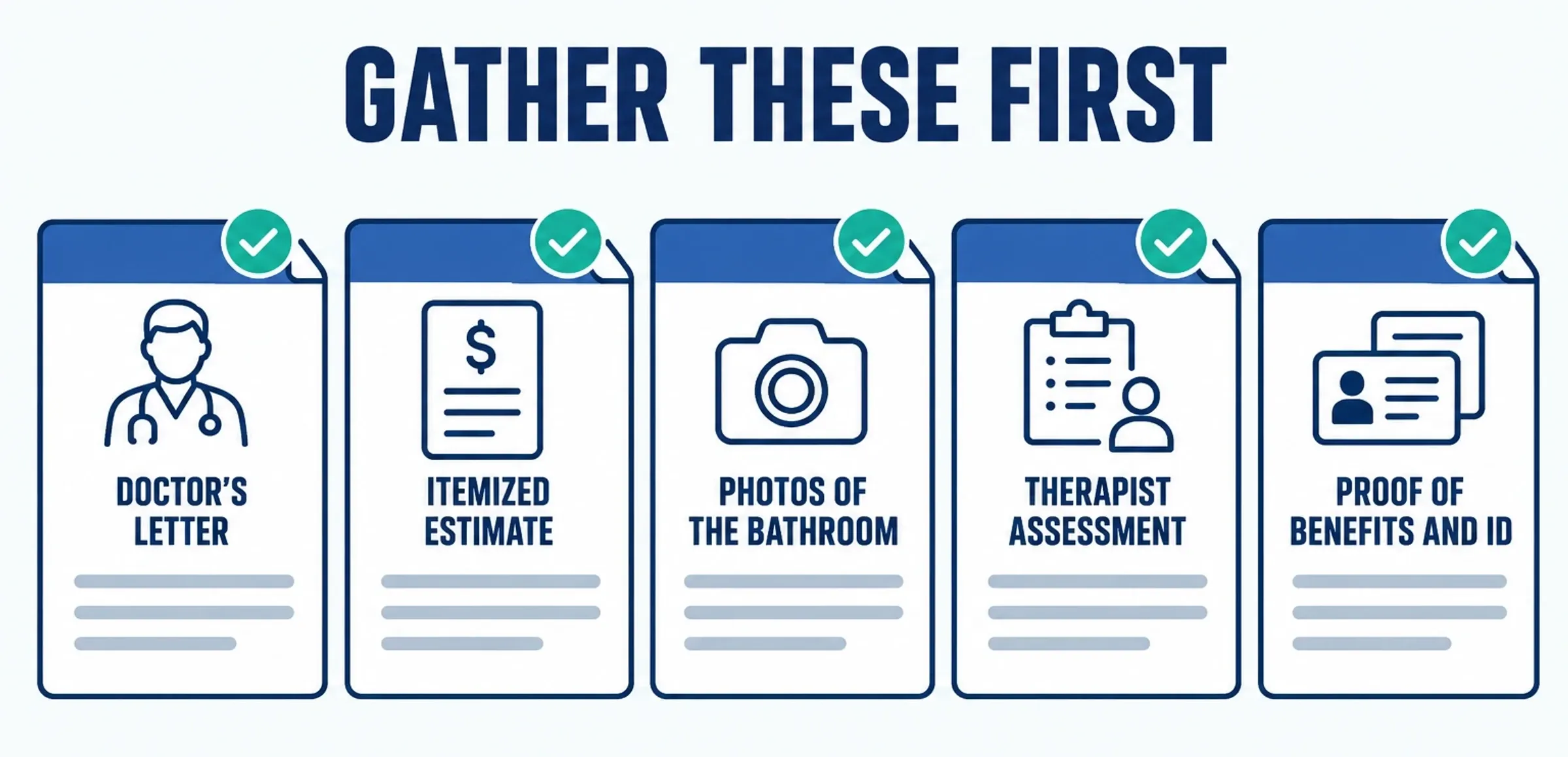
The five documents almost every program asks for.
- A doctor’s letter. It should name the diagnosis, describe the functional problem (for example, “cannot safely step over the tub wall”), say why a specific change is medically necessary, and be signed and dated. VA applications need a prescription from a VA physician.
- A written, itemized estimate. It should break out labor, materials, plumbing, permits and installation so a reviewer can see what each part costs. A single lump sum is often rejected.
- Photos of the bathroom as it is now. Include the tub, the floor, the doorway and the water heater.
- A therapist’s assessment, when asked. A physical or occupational therapist can assess the person’s mobility and recommend the fixture. Medicaid waiver programs and some Medicare Advantage plans want it.
- Proof of benefits and ID. Your Medicare, Medicare Advantage, Medicaid or VA numbers, and proof of ownership or the owner’s signed permission if the home is rented.
After our free in-home visit we send a written, itemized estimate, and we can explain what each line covers. We do not apply for benefits for you, but we can give your case manager, counselor or VA office what they ask to see.
Before you buy: what a walk-in tub needs from your house
Walk-in tubs are not a drop-in replacement, and the problems are not on the sales sheet.
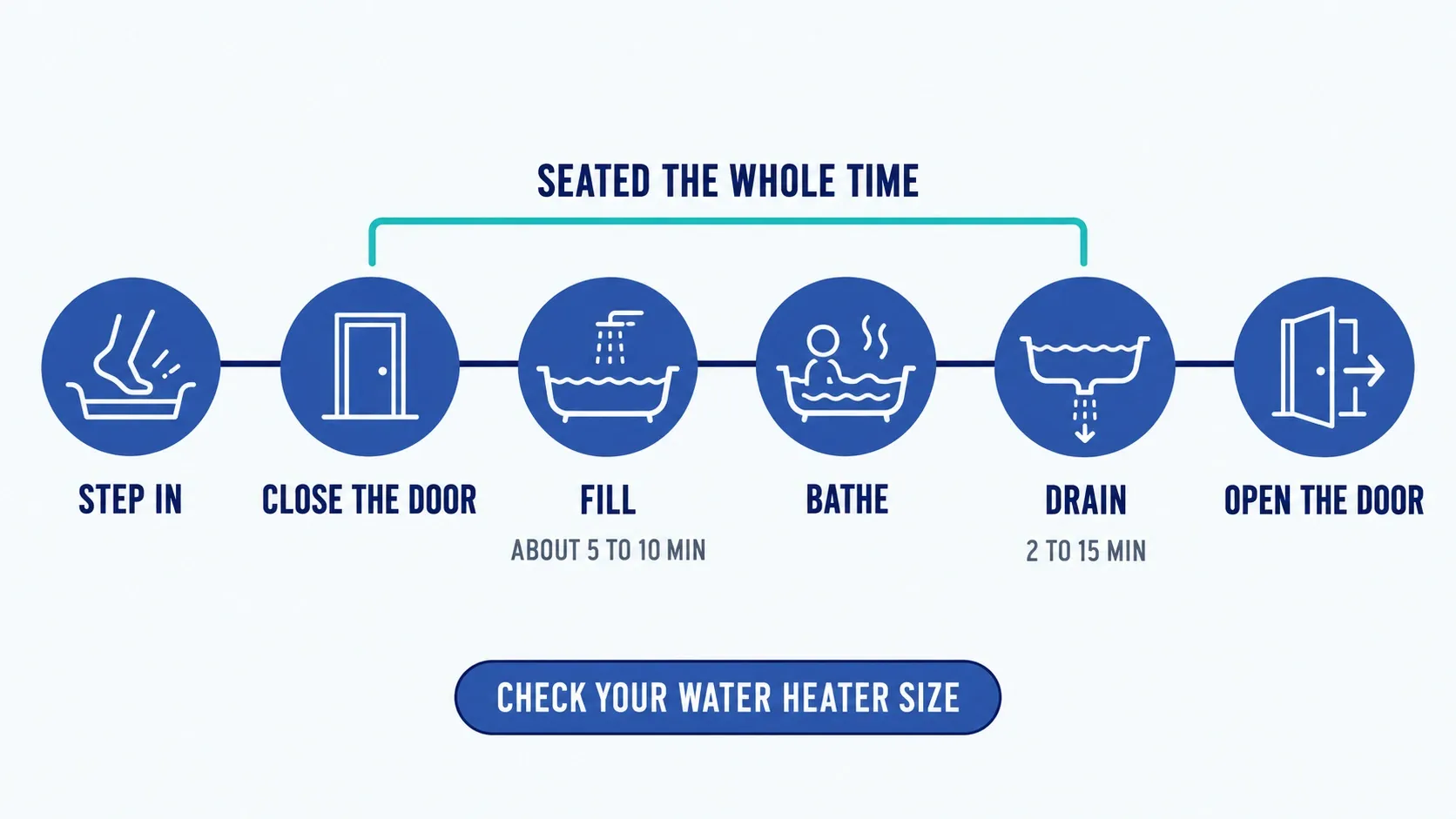
Why a walk-in tub means sitting and waiting. Plan around the fill and drain times.
- You sit and wait. You get in, close the door, and the tub fills while you sit. You cannot open the door until the water has drained, or the water comes out. Consumer guides report fill times of roughly 5 to 10 minutes and drain times that range from 2 or 3 minutes with quick-drain models to 15 minutes with standard drains. A person who gets cold or has trouble sitting still for that long may do better with a shower.
- Hot water. A walk-in tub holds more than a standard tub, often 40 to 80 gallons. Retirement Living suggests a water heater with at least two-thirds of the tub’s capacity, and other guides cite 50 gallons or more. The manufacturer’s specifications give the number for your model. If your water heater needs a look, our on-site plumber or a plumber we recommend can check it.
- Floor, plumbing and space. The tub is heavy when full, needs the right drain position and may need electrical work if it has jets or a heater. Doorways and the floor beneath may need attention.
- Daily use. Can the person get in and out of the door and onto the seat alone, and reach the controls? A tub that suits a caregiver’s visit may not suit a Tuesday morning alone.
- A shower may be the better fit. If the person mostly needs to step in without lifting a leg, a walk-in or curbless shower is often faster, cheaper to use and easier to fund, since programs like the VA name roll-in showers outright. Our guide to curbless showers explains the options. A tub is the better answer when the person needs to soak for pain or stiffness.
We install both: see our walk-in tub and walk-in shower pages, and our broader wheelchair accessible bathroom work. We will tell you if a shower fits better.
Red flags: “Medicare approved” and high-pressure sales
- “Medicare approved” or “ADA approved.” Neither is a real approval for a walk-in tub. If you hear it, ask for the claim in writing and then call 1-800-MEDICARE or the Oklahoma Insurance Department’s counselors at 1-800-763-2828.
- Pressure to sign today. A real offer is still there tomorrow. Take the quote home.
- Asking for your Medicare number for a “free” tub or consultation. Do not give it out.
- The three-day cancellation right. Under the FTC’s Cooling-Off Rule, you generally have three business days to cancel a sale of $25 or more made at your home, and the seller must tell you so in writing.
- A lump-sum price. Ask for the itemized estimate. It makes comparing sellers possible.
- Unclear warranty and who services it. Ask who answers the phone in year three, and in writing.

Taking it one step at a time makes the paperwork manageable.
A step-by-step plan for a parent
Tick these off as you go. Your progress is saved in this browser.
- Ask the person what is hardest: stepping over the tub wall, standing, getting out, or the cold. The answer decides tub or shower.
- Call the doctor and ask for a letter that names the medical reason and the specific change needed.
- Look up which plans the person has: Original Medicare, Medicare Advantage, Medicaid, VA, long-term care insurance.
- If there is a Medicare Advantage plan, check the Evidence of Coverage and call with the five questions above.
- If the person is a veteran, call the local VA Prosthetic and Sensory Aids Service before buying.
- If the person may qualify for Medicaid, ask Oklahoma Human Services about the ADvantage Waiver.
- Get an itemized written estimate and photos of the bathroom.
- Check USDA’s map, Revitalize T-Town, and the Eldercare Locator for help.
- Ask a tax professional about the medical expense deduction.
- Compare at least two itemized estimates, and do not sign on the spot.
Questions to ask any walk-in tub seller or installer
- Does it have jets or air massage? (The VA excludes spa and Jacuzzi-type tubs.) Is it a plain soaker, a hydrotherapy or a combination tub?
- How long does it take to fill and drain, and does it come with a quick-drain system?
- What water heater size or recovery does it need?
- Who does the plumbing and electrical work, and does the job need a permit where I live?
- What exactly is included in the price: removal of the old tub, floor repair, new drain, wall surround, trim and disposal?
- What does the warranty cover, for how long, and who services it locally?
- Can I have the itemized estimate in writing, with a doctor’s letter if needed, for my case manager?
Where we fit
We are a locally owned remodeler serving Owasso and the whole Tulsa metro. We visit your home at no cost, look at the bathroom, measure, and talk through the options, with no obligation, and your itemized written quote follows in 1 to 2 days. If a walk-in tub is the right answer, we install it. If a shower would work better, we say so. We do not finance in house, and our guide to what a bathroom remodel costs in Tulsa covers budgets, permits, quotes and the local lenders families use. Our Owasso page looks at the town’s homes, and our Claremore page compares the VA’s HISA, SAH and SHA grants side by side. One of our own jobs was paid for outside Medicare: a roll-in shower for a Korean War veteran in Glenpool, funded by a credit union foundation.